Showing posts with label neuropsychology. Show all posts

Monday, 16 March 2009

Musicians' brains keep time--with one another

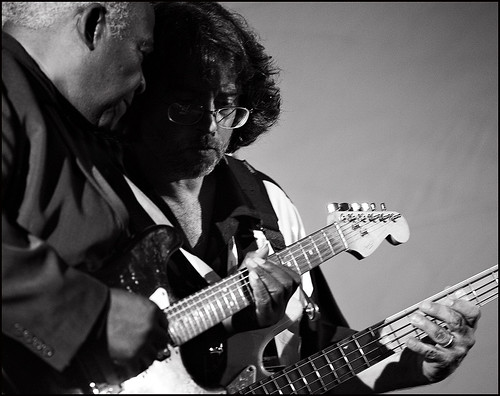
Scientific American Blog: "The synchrony was most prominent in the frontal and central parts of the brain that regulate motor function. 'Whenever synchrony of behavior was high, synchrony of brain waves were also high,' Ulman Lindenberger, a director the Max Planck Institute for Human Development in Berlin, tells ScientificAmerican.com. But, 'we can't assign a causal role to that synchronizing.'

While brain synchrony during a duet seems like a given, it's a mystery how it happens, says Lindenberger, a psychologist. 'One could speculate that this may be related to mirror neurons, the capacity of primates and humans to imagine the action of the other person while performing actions yourself,' he says. 'The mirror neuron system could be active during synchronized guitar playing.'

Lindenberger says that inter-brain synchrony may also help explain humans' ability to engage in a host of other activities and behaviors that involve couples or teams, such as dancing, boxing, tennis and mother-child bonding. 'People have an extraordinary capacity to synchronize their actions,' he says. 'When two people concentrate on the same thing, gestures and head movements are highly coordinated and supported by brain synchronicity. We think what we are getting through music has wider implications and social bonding behaviors are part of those wider implications.'"
A further implication: the sum energy of adding waves increases as the square of the number of sources when the sources are in phase, which is to say when they are synchronized, yes, but also when those sources are proximally co-located, say, for example, on a small live stage. This seems a very strong case against any equivalence of sound and the subjective qualia of music, a myth that lead us to multitrack recording and replacing live musicians with pre-recorded sound as if they were the same; the broadcast psychic energy-wave of the canned and asynchronous performances simply could not gain anywhere near the same intensity as the living sound.

Wednesday, 21 January 2009

Learning Makes Itself Invisible

Learning SHOULD Be Fun: Tom Stafford writes "In lots of teaching situations we focus on the right and wrong answers to things, which is a venerable paradigm for learning, but not the only one. There is a less structured, curiosity-driven, paradigm which focusses not on what is absolutely right or wrong, but instead on what is surprising. A problem with rights and wrongs is that, for some people, the pressure of being correct gets in the way of experiencing what actually is.
[youtube http://www.youtube.com/watch?v=4n_i4b4Wy-M&hl=en&fs=1]
You can try this for yourself, either in any teaching you do, or any learning. Often we will get blocked at a particular stage in our learning. A normal response is to try harder, and to focus more on what we're doing right, and what we're doing wrong. Sometimes this helps, but sometimes it just digs us further into our rut. The way out of the rut is to re-focus on experiencing again."
See also Tom's essay on the always-additive nature of learning at School of Everything: "Once you have learnt something you see the world differently. Not only can you appreciate or do something that you couldn't appreciate or do before, but the way you saw the world before is now lost to you. This works for the small things as well as the big picture. If you learn the meaning of a new word, you won't be able to ignore it like you did previously. If you learn how to make a cup of out of clay you won't ever be able to see cups like you used to before."

Wednesday, 9 July 2008

The incredible Sargy Mann

The incredible Sargy Mann and the amazing powers of the brain: "It was really a dazzling festival of colour. There were exquisite juxtapositions – brilliant orange against light green, violent red against a nervous purple, a yellow against a calming blue. All the paintings were representations of his wife, Frances.
[youtube http://www.youtube.com/watch?v=XNteWnGXRaU&hl=en&fs=1]
What is amazing about all this is that these are the paintings of Sargy since he became completely blind."