"Considering the roots of Electronic in Cage ... I do find it surprising that its so hard to find any records just wanting to be records."and even more surprising still that I could find so few Cage recordings!
Showing posts with label music. Show all posts
Showing posts with label music. Show all posts
Tuesday, 10 March 2015
Whither Ambient?
Whither Ambient? – Last.fm (2008): an essay on my quest to find true electronic ambience that is present in the current moment and now replayed shadows from some past space and time. It turned out to be harder to find than I thought, although admittedly I had added some tough criteria, not the least of which is that the sound should "Be not a cancer on this Earth. Leave room for nature!"
Monday, 29 July 2013
Sun Ra Charts | Tone Science
Sun Ra Charts | Tone Science: a very nice collection of over 90 charts from Sun Ra covering 1936-1978. Most were composed by Sun Ra, but there are also charts by Ronald Boykins, Julian Priester, Marshall Allen and others.
For me, part of the fascination with this music is seeing the evolution of Sun Ra’s name. The earliest chart, from December 1936
And now here they are, at long last, out in the open air. Let the wild rumpus begin!
For me, part of the fascination with this music is seeing the evolution of Sun Ra’s name. The earliest chart, from December 1936
Allan Chase clarifies the Mystery: "Paper copies of most of these, and some not here, appeared somewhat mysteriously, unsolicited, in two large packages in the mailboxes of some known Sun Ra researchers and aficionados, including me, I believe in the late 1990s. I’m pretty sure it was after the Szwed bio and Robert Campbell discographies were published, and I know it was well after my 1992 MA thesis on Sun Ra’s music. Not sure of the legalities involved! These are mostly sketch scores prepared for copyright documentation; for example, to save fees, he would present groups of discrete compositions as “suites” so several could be copyrighted for one fee. The notes that are there are accurate, as far as I can see — most of the Sun Ra pieces are in his own hand, and he was meticulous — but not all the parts or harmonizations are there, and we know from one video and one CD that he dictated and changed harmony parts in rehearsal, as well as writing them. Some of these are confusing: “Shadow World” doesn’t resemble the recorded versions, to my knowledge — correct me if I’m wrong. “Advice to Medics” seems to include Sun Ra’s own transcription of his improvisation, far more detail than needed for copyright, and it’s a solo Wurlitzer piece (speeded up on record — goes above range of Wurly, as my student Eric Lane noticed.) “Space Loneliness” suite seems to be missing here, and contains many of the great tunes of the time. But there are some tunes here I didn’t have, by others (Richard Evans, for ex.). I could go on…Thanks!I received my own copy from a wishes-to-be-anonymous source about ten or fifteen years ago, a precious brown-paper wrapped package of deep esoteric wisdom I've been pondering ever since, and likewise studying the evolution in Sun Ra's charts, but also constantly amazed at how complete his conception had been even from the very start of the Arkestra.
And now here they are, at long last, out in the open air. Let the wild rumpus begin!
Monday, 25 February 2013
Be Bop Wino: Blow "Mr. Low-Blow" / Lyin' Girl Blues - Red Saunders and his Orchestra (Columbia 30218)
 Recorded in Chicago, June 15th, 1950. Personnel: Hot Lips Page, Sonny Cohn (trumpets); Harlan Floyd, John Avant (trombones); Porter Kilbert (alto sax); Leon Washington (tenor sax); McKinley Easton (baritone sax); Earl Washington (piano); Jimmy Richardson (bass); Jumpin' Joe Williams (vocal); Sonny Blount (arranger).
via Be Bop Wino: Blow "Mr. Low-Blow" / Lyin' Girl Blues - Red Saunders and his Orchestra (Columbia 30218).
Sunday, 24 February 2013
How Do You Rehearse The Unknown?
Wayne Shorter On Jazz: "The six years I was with Miles, we never talked about music. We never had a rehearsal. Jazz shouldn't have any mandates. Jazz is not supposed to be something that's required to sound like jazz. For me, the word 'jazz' means, 'I dare you.' The effort to break out of something is worth more than getting an A in syncopation."

"This music, it's dealing with the unexpected. No one really knows how to deal with the unexpected. How do you rehearse the unknown?"
Thursday, 21 February 2013
language from birdsong: deep roots of human speech

How human language could have evolved from birdsong: Researchers propose new theory on deep roots of human speech: our finite vocabularies can generate a seemingly infinite string of words. Indeed, the researchers suggest that humans first had the ability to sing, as Darwin conjectured, and then managed to integrate specific lexical elements into those songs.
seems first you sing ...
and then you have to say something
Wednesday, 5 September 2012
John Cage Centennial
[youtube http://www.youtube.com/watch?v=pcHnL7aS64Y?wmode=transparent]
via youtube.com
Happy Birthday John Cage, 100 years young, and still not a day goes by when I do not reminisce on your accepting laughter. Some days all it takes is the sound of street traffic.
Monday, 20 February 2012
Musicians Wage War Against Robots

via Paleofuture
"The true function of the machine is to increase the value of the product fed into it -- not to debase it. Therefore mechanical music, as a substitute for Living Music, is a spurious form of progress -- Like a loom converting good wool into shoddy."
"Trampling Art for Profit" -- alas, if only we'd listened! Click the Paleofuture link there for more thoughts on the essential role of human contact in the "social intercourse" of music, a parade of ads put forth by the 1930's AFM Music Defense League's $50,000 newspaper campaign to demand using humans, not machines, to play our music. Ditto on the sweaters too.
Thursday, 21 April 2011
Everything popular is wrong: Making it in digital music, despite democratization
Everyone keeps doing the same thing out of the fear that the slightest deviation from the norm will scare away the small remaining, yet patient audience who goes along because of a lack of alternatives (we dance either because we paid or because the drugs kicked in).
Nasdaq studioDid that depress you? Now, here comes the good news: exactly because everyone seemingly performs to the lowest still acceptable standards, all you have to do as an artist is to unleash disproportional waves of creativity. Since nothing promises secure success anymore, all considerations to what ???works in the marketplace??? can be freely dumped and forgotten. The more out there you get, the better. It???s the only way to stand out in a totally dull environment. The advantage is, put cynically, that the old channels are jammed. Whoever tries to break through them following ???proven??? old ways (which usually means emulating other people???s career paths) is wasting time and energy.

A very thoughtful article by Stefan Goldman, well worth the read; he has a point and he sets out some decent advice: 'step outside the box' appears to work here and there, at least momentarily, perhaps enough to get to that next gig and, as one commenter puts it, "killing expenses, whatever it takes to immerse in the task full time, and maybe I am misunderstanding his gist, but ... what if that's not all there is?
What if it is not the chops that need perfecting, but the one who wields the axe? This is my own approach, although admittedly I really suck at it, but I figure, as Gene Krupa put it, if you're going to die, you might as well die doing your own thing.
To be a workable theory of art, one must rest on one's priors, so let us consider what Pablo Picasso said:
???Art is just another way of keeping a diary???
If this is so, then our way to garner audience attention is not simply to out-do the oddity of our last LOLCats post, but to be an interesting diarist, to be someone who has something to say, and interesting to a degree that we really want to know what that person is going to say next. So we the audience hang on the feed awaiting the next releases, and through that person, we discover others who are also following these ideas and in there we have a community, a network.
Whether you are a minstrel or a symphony orchestra, given a tuned-in network of like minds, all sorts of commerce-like things can happen; given a large enough network, it starts to feedback and self-inspire itself, and given a still larger network, sales people will get interested in piggy-backing on it (which is not always, if ever, a Good Thing)
This, it seems to me, is a fair description of the successes we see in the wild, of, for example, phenomena we today call Darcy James Argue and The Bad Plus: artists with a message and a mission, the mission itself transcendent of the particular temporal recordings so much so that someone else in a pub playing Transit is still interesting, but clearly not as much so. The work is only a step in the evolution, a transition point on a journey and we are invited along for the ride.
The key here is in being an interesting art diarist, in becoming, in having something to say in the next work that expands on what was said in the work before; it says nothing about the low barriers to entry or the ease of posting any doodle to iTunes. In an art, there needs be a direction, a vector out of the past and through the present into some place in tomorrow.
Beethoven didn???t just dream up nifty sounds that were ???neater??? than the last, he had a system, he was on a quest, he had a theory of where his music had to go; each and every composition (outside of commissions for money) was a targeted probe, a further exploration into that space, each new symphony was the logical successor to the prior, building from the learning experience, going forward with a purpose.
Mahler then picked up from Beethoven, and kept running, another interesting musical ???diarist???; Schoenberg then did the same, and Cage ditto. Each was moving in a direction, applying themselves to exploring where this thing we call music had to go, inevitably, carrying things to their logical conclusion. This is the passion that propelled them. It wasn't about penthouse suites. It wasn???t about spandex and wigs and arriving in a cocoon.
So it behooves the artist to become interesting first, and then make their art out from that foundation, tangible proof of their point. To be 'experimental' is more than just being weird and 'unique', it is about gathering experience and confirming or challenging the working hypothesis.
To some extent the ear-candy people are doing this too, only the theory they are applying towards is finding maxima in sales and bums in seats, which, to be fair, is nonetheless a quest and a scientific endeavour that has lead them to all sorts of clever inventions in the pursuit of cash register and ticket receipts.
I would just, myself, however, hope to find me some diarists with something a tad more interesting to say, and more over hope as well to be one :)
Monday, 3 January 2011
Rock and Roll (1949-2011)
Bereft of budgets or motivated staffs, the rock music business has been hard-pressed to support the promotion and marketingefforts necessary to build acts and buzz. Without traditional record stores, there no longer are outlets in which to hype must-have recordings. In the past, record companies used to create personalities for artists, so when you bought albums, you felt a kinship to one or more of the artists. With the decline of newspaper, magazine and book reading by the youth culture, the personalities and philosophies of rock artists have become meaningless and moot.
via jazzwax.com
I used to say that I'd feel old the day I saw Sir Paul McCartney as the guest host on The Tonight Show; JazzWax may be a little tongue in cheek here riffing on the horse theme of 'Jazz is Dead' so often flogged when there's not much else to write about, but then again, the numbers don't lie, and all around it does very much seem quite plausible Rock's long since jumped the shark and the boomers may very well take their hype machine with them. The sad and tragic part, though, is Rock didn't take its own advice, to stay pretty by dying young.
Friday, 17 December 2010
no Cage preview?
Dear BBC Radio 1
regarding your update chart page at http://www.bbc.co.uk/radio1/chart/update/singles --??why is the John Cage single (#18: 4'33") the only??track on the chart list which does not have an audition preview button?
Wednesday, 9 December 2009
Christmas Curtain Raiser
[youtube http://www.youtube.com/watch?v=gwMwzjhcNiY&hl=en_US&fs=1&rel=0&color1=0x5d1719&color2=0xcd311b&border=1]
Traditional carol mash-up by Sinfonia alumnus Ross Hasting, "Christmas Curtain Raiser" (Alfred Publ 1971) rendered here by the Heritage High School Concert Band (aka the Marching Mountaineers)
Traditional carol mash-up by Sinfonia alumnus Ross Hasting, "Christmas Curtain Raiser" (Alfred Publ 1971) rendered here by the Heritage High School Concert Band (aka the Marching Mountaineers)
Tuesday, 27 October 2009
Billboard - Google Books

Billboard - Google Books: "In its 114th year, Billboard remains the world's premier weekly music publication and a diverse digital, events, brand, content and data licensing platform. Billboard publishes the most trusted charts and offers unrivaled reporting about the latest music, video, gaming, media, digital and mobile entertainment issues and trends."
Thursday, 28 May 2009
Jazz For Beginners

selected for enjoyablility as well as importance, from the broad "modern" period extending from 60 - 2000. excluded are both earlier classic styles such as Dixieland or Big Band, also leaving out later day completely improvised/free recordings.
via Different Waters
A wonderful list, widely scoped and very accessible, completely endorsed by Mr.G, although I might have included more newcomers like Butch Morris's conductioned NuBlu Orchestra, the harmolodious The Bad Plus, and Darcy james Argue's big band Secret Society with their brand new CD Infernal Machines
Monday, 30 March 2009
A Coming Paradigm Shift in (Online) Music

FAßCINATED: "For starters, it seems to me that over the course of history very little of what we now think of as great music was produced specifically because the people making it were concerned about making the music a commercial success"
I know many of you have heard me say nearly this verbatim, and I know many who have rolled their eyes at it, but here it is, proof of the existence of at least two others out there who share my "naturally unpopular but important" point of view.I'll go one farther too, and point out that all of the musics now considered marketably popular, be that hip-hop or baroque, bebop or troubadour, without exception all genres were pioneered by people who weren't in it for the money, and only later appropriated and exploited by the unimaginatives who were. Yes, I know, that's a pretty strong generalization, but I am open to any spectacular counter-examples.
Monday, 16 March 2009
Musicians' brains keep time--with one another
Scientific American Blog: "The synchrony was most prominent in the frontal and central parts of the brain that regulate motor function. 'Whenever synchrony of behavior was high, synchrony of brain waves were also high,' Ulman Lindenberger, a director the Max Planck Institute for Human Development in Berlin, tells ScientificAmerican.com. But, 'we can't assign a causal role to that synchronizing.'

While brain synchrony during a duet seems like a given, it's a mystery how it happens, says Lindenberger, a psychologist. 'One could speculate that this may be related to mirror neurons, the capacity of primates and humans to imagine the action of the other person while performing actions yourself,' he says. 'The mirror neuron system could be active during synchronized guitar playing.'
Lindenberger says that inter-brain synchrony may also help explain humans' ability to engage in a host of other activities and behaviors that involve couples or teams, such as dancing, boxing, tennis and mother-child bonding. 'People have an extraordinary capacity to synchronize their actions,' he says. 'When two people concentrate on the same thing, gestures and head movements are highly coordinated and supported by brain synchronicity. We think what we are getting through music has wider implications and social bonding behaviors are part of those wider implications.'"
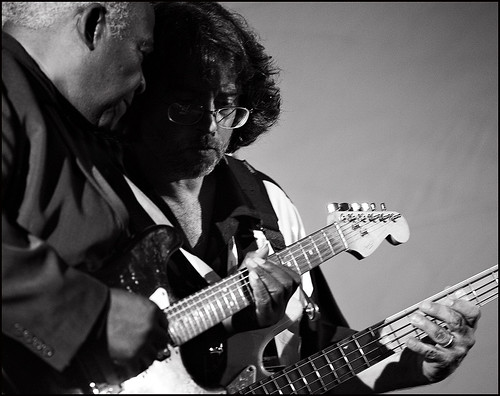
While brain synchrony during a duet seems like a given, it's a mystery how it happens, says Lindenberger, a psychologist. 'One could speculate that this may be related to mirror neurons, the capacity of primates and humans to imagine the action of the other person while performing actions yourself,' he says. 'The mirror neuron system could be active during synchronized guitar playing.'
Lindenberger says that inter-brain synchrony may also help explain humans' ability to engage in a host of other activities and behaviors that involve couples or teams, such as dancing, boxing, tennis and mother-child bonding. 'People have an extraordinary capacity to synchronize their actions,' he says. 'When two people concentrate on the same thing, gestures and head movements are highly coordinated and supported by brain synchronicity. We think what we are getting through music has wider implications and social bonding behaviors are part of those wider implications.'"
A further implication: the sum energy of adding waves increases as the square of the number of sources when the sources are in phase, which is to say when they are synchronized, yes, but also when those sources are proximally co-located, say, for example, on a small live stage. This seems a very strong case against any equivalence of sound and the subjective qualia of music, a myth that lead us to multitrack recording and replacing live musicians with pre-recorded sound as if they were the same; the broadcast psychic energy-wave of the canned and asynchronous performances simply could not gain anywhere near the same intensity as the living sound.
Wednesday, 4 March 2009
Terry McBride on DRM

Rollo & Grady - Los Angeles Music Blog: Interviewing Terry McBride, CEO of Nettwerk Music Group - "I didn’t see any purpose in locking down files; it made no sense to me. People have always been sharing music. Why would I want to stop them? Why would I want to tell them what to do? The way to win was to get them to support my artists, not to force them to do it a certain way. I know I wouldn’t like anyone telling me that."
“The future of music isn’t selling records. It’s selling music in every form imaginable.” As a result, he shifted the company’s focus to the Internet and digital distribution in order to market his clients’ music. Those changes have paid off.
Saturday, 31 January 2009
The Ultimate Music Promotion Tool
A Creative Commons License Is The Ultimate Music Promotion Tool: Avant Music News cites a common thread heard 'round the world -- "I sold a few copies - but eventually came to a realization I would rather have my music reach more ears as the money I was making was worth far less than the joy of being able to share it with others. Soon after that, I released my latest album along with a few of my older works under a creative commons license.
My goal with art shifted to purely enjoying the process, and I didn’t even worry about promoting it, I just uploaded it. And believe it or not, that’s when the real magic started to happen."
Someday let me tell you how I became certifiably Canada's most listened to modern symphonic composer.
My goal with art shifted to purely enjoying the process, and I didn’t even worry about promoting it, I just uploaded it. And believe it or not, that’s when the real magic started to happen."
"The galaxy's awaiting
the planet Earth's awakening."
Someday let me tell you how I became certifiably Canada's most listened to modern symphonic composer.
Tuesday, 20 January 2009
The Stepping Stone
Casa Valdez Studios: Dr. Martin Luther King, Jr., Opening Address to the 1964 Berlin Jazz Festival - "Much of the power of our Freedom Movement in the United States has come from this music. It has strengthened us with its sweet rhythms when courage began to fail. It has calmed us with its rich harmonies when spirits were down.
[youtube http://www.youtube.com/watch?v=TR5b0Eryr1U&hl=en&fs=1]
And now, Jazz is exported to the world. For in the particular struggle of the Negro in America there is something akin to the universal struggle of modern man. Everybody has the Blues. Everybody longs for meaning. Everybody needs to love and be loved. Everybody needs to clap hands and be happy. Everybody longs for faith.
In music, especially this broad category called Jazz, there is a stepping stone towards all of these."
[youtube http://www.youtube.com/watch?v=TR5b0Eryr1U&hl=en&fs=1]
And now, Jazz is exported to the world. For in the particular struggle of the Negro in America there is something akin to the universal struggle of modern man. Everybody has the Blues. Everybody longs for meaning. Everybody needs to love and be loved. Everybody needs to clap hands and be happy. Everybody longs for faith.
In music, especially this broad category called Jazz, there is a stepping stone towards all of these."
Friday, 16 January 2009
The Best-Selling MP3 Album of 2008 ... was free
Because Amazon is so easy to use? I don't buy that argument if only because the payment transaction itself is several screens long. The only answer left says the NiN fans were assured far more of the (reasonable price) $5 they spent would go straight to their idols, coupled with their just wanting to be a part of the hyped temporal happening of it all.Curiously, or maybe not curious at all, there is a lot of freely trade-friendly file-shared artists in the Amazon lists.
Monday, 29 December 2008
There's Me And There's You

The Matthew Herbert Big Band - There's Me And There's You: Matthew Herbert writes "In an age of such infinite and brilliant possibilities of technique, combined with the urgent politics of now, why have music and musicians lost the urge to challenge, investigate, invent and unite? Without the backbones of principle and enquiry, music is sounding more and more like the background to a non-stop Ford commercial"
"we, the undersigned, believe that music can still be a political force of note, and not just the soundtrack to over-consumption" -- if he can generalize that if-or-else to "healing force" (ie Yue) then I'm with him 100%
Subscribe to:
Posts (Atom)